
Vaibhav Sooryavanshi Can His Fielding Match His Batting Potential


Vaibhav Sooryavanshi has already made people stop and watch. The bat speed, the freedom, the willingness to take on high pace and spin without shrinking from the moment, all of it marks him out as one of India’s most exciting young batting talents.
His early rise has been built on impact. In the IPL environment, he has shown the kind of fearless hitting that forces bowlers to change plans quickly. He does not look like a player waiting for permission to dominate. He looks to impose himself, and that matters in modern T20 cricket.
Since earning the opportunity to represent India in the pathway system, he has also impressed with the bat against sides such as Zimbabwe and Ireland. Those performances have added weight to the view that India may have another left-handed attacking option with a high ceiling.
But there is a second question now, and it is a serious one.
Can his fielding match his batting potential?
In the modern white-ball game, selection is rarely about batting alone. T20 cricket punishes weak links. If a player gives back 8 to 12 runs in the field, misses a run-out chance, or allows batters to turn ones into twos, the value of a brilliant 35 off 18 can shrink quickly.
His batting has moved faster than the normal timeline
Sooryavanshi’s rise feels unusual because he plays with such clarity. Young batters often have shots but not certainty. They can strike the ball cleanly, yet still look unsure about when to attack.
His game has been different. He appears comfortable taking risks early. He backs his swing. He commits fully. That is why his IPL success has attracted attention far beyond highlights and scorecards.
For coaches, the interesting part is not just that he hits boundaries. It is how he approaches them.
He does not look overawed by status. He is willing to take on bowlers who are older, stronger, and more experienced. That fearless approach is valuable because T20 cricket is not patient with hesitation. The game rewards players who can make aggressive decisions under pressure and live with the result.
That same quality has carried into his India opportunities. Runs against Zimbabwe and Ireland have helped build the picture of a player who is not just a domestic story. He has started to show he can transfer his intent into representative cricket.
That is why the fielding debate matters. If a batter has this much attacking upside, every part of his game will be examined through an international lens.
Search the phrase cricket fielding athletic Vaibhav sooryavanshi IPL and the question is clear: can a thrilling young hitter become a complete modern cricketer?
The modern T20 fielder has a high job description
There was a time when teams could hide a weaker fielder. Captains placed them at fine leg, third, or somewhere the ball was less likely to find them. That era has largely gone.
Modern T20 batting maps are too wide. Players sweep pace. They reverse spin. They access both sides of the wicket. They hit hard down the ground and manipulate gaps. The ball finds everyone.
A white-ball fielder now needs to do several jobs well:
Hold catches under lights
Save singles inside the ring
Stop twos from the boundary
Throw hard and flat from distance
Release accurately while off balance
Repeat high-speed efforts across a full innings
Stay engaged even after a poor ball or missed chance
Be an athlete...
This is where Sooryavanshi’s fielding currently sits under pressure. His batting ceiling is very high, but his athletic base does not yet appear at the same level.
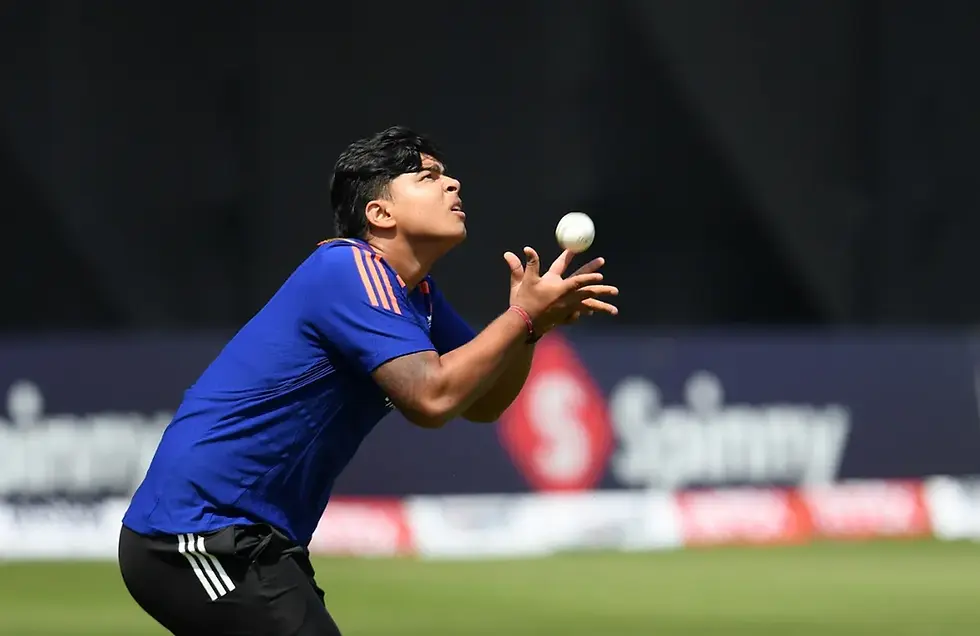
That is not an insult. It is a development point.
At international level, athleticism is not just about looking quick in one moment. It is about repeating the same movement quality again and again. Sprint, brake, turn, dive, roll, throw, reset. Then do it again two balls later.
For a young player, that repeatability often takes time. Some players grow into it. Some require structured work. Some have acquired these skills from other sports. Some must reshape their body composition, running mechanics, and fielding habits over several seasons.
Sooryavanshi looks like he falls into the category of a player with clear batting gifts and fielding work still ahead of him.
The boundary test is a real measure
One of the simplest ways to judge a white-ball outfielder is to ask a practical question.
Can he shut down twos on a 65 to 70 metre boundary?
At elite level, the best boundary fielders do not only chase the ball. They manage angles. They move early before the balls been hit. They get their feet around the ball. They collect cleanly with momentum. They throw in one smooth action.
If the fielder takes an extra step to gather, bobbles the pick-up, or needs to steady before throwing, good batters will run. In T20 cricket, that matters as a single is taken in under 3 seconds.
At present, Sooryavanshi probably does not yet project as the fielder who consistently turns twos into ones from the rope. That may change, but this is the current gap.
The issue is not courage. It is not desire. The issue is physical output and repeatable movement.
A 65 to 70 metre boundary demands:
Speed over the first 10 metres
Efficient curved or direct running lines
Clean pick-up technique (balanced and off balanced)
A fast transfer from hand to throw (arm slots)
Enough arm speed to keep the throw threatening
If any link is weak, elite batters sense it. They do not need a team analyst to tell them. They watch the first chase, the first throw, the first hesitation. Then they take the extra run.
The inner-ring test may be even tougher
Boundary fielding is visible. Inner-ring fielding is often more demanding.
Inside the circle, a fielder has less time, more awkward body positions, and a higher cost for hesitation. The question here is direct.
Can Sooryavanshi cover 3 to 5 metres, dive or roll, and cut off a firm cover drive that would otherwise reach the boundary?
Right now, probably not consistently.
That does not mean he cannot catch. He has already produced moments of quality, including strong ground coverage and excellent catches in last year’s U19 World Cup. Those moments matter because they show he is not a passive fielder. He can track the ball. He can judge height and distance. He can complete difficult chances.
But world-stage fielding is judged by the ordinary ball, not only the spectacular one.
A brilliant catch may win applause. A hard stop at cover in the sixth over may win the match.
The modern ring fielder needs low hips, quick feet, and the ability to attack the ball without over-running it. They need to dive safely, roll through contact, and return to their feet without losing too much speed. They also need to throw from positions that are not clean or comfortable.
This is where agility becomes central. Not gym agility in a cone drill, but cricket agility.
That means:
Reading the batter’s shape before contact
Moving on the correct line
Adjusting late if the ball is sliced
Staying low enough to dive
Getting the ball into the throwing hand fast
Releasing from different body positions
For a young player with Sooryavanshi’s batting gifts, this area could decide how quickly he becomes a trusted all-format white-ball option rather than a batting-only prospect.
Throwing will shape how teams use him
Throwing is the part of fielding that often separates serviceable fielders from true pressure fielders.
A strong throw from the boundary changes running decisions. Batters think twice. They settle for one. They stop taking on the second to the weaker side. Captains can then protect match-ups and bowling plans with more confidence.
The question around Sooryavanshi is whether he currently has the throwing ability to cover distance from the boundary at speed. Would elite batters take him on? At this stage, probably yes.
Again, that is not a final judgement. It is a realistic projection of where he appears to be.
Throwing from the rope is one layer. Throwing inside the circle is another.
Can he throw off balance? Can he release from different arm slots? Can he attack a slow single, pick up one-handed, and hit the keeper’s gloves without needing perfect footwork? Can he create run-out chances when the match is tight and the batter is already moving?
Probably not yet.
This is normal for many young cricketers. Throwing under pressure is a skill built through thousands of specific reps. It is also linked to strength, trunk control, shoulder capacity, and footwork. A player cannot simply “try harder” and become a better thrower.
The key is building a throwing programme that matches cricket, not just a generic arm-care plan.
He will need:
Long throws that develop distance without forcing poor mechanics (long toss)
Fast pick-up and release drills from the boundary (using the lower body)
Off-balance throws from cover, point, and mid-wicket (Footwork and 4 corners)
Low-arm and side-arm releases for run-out chances
Staying calm when the batter is running at full speed
His U19 fielding moments should not be ignored
It would be unfair to frame Sooryavanshi only through what he cannot yet do.
He has already shown credible fielding moments at age-group level. His U19 World Cup work included brilliant catches and examples of covering ground well. Those are not small signs. They show he has the appetite for the contest and the ability to produce under attention.
For a young player, this matters.
Some batters treat fielding as a waiting room until they can bat again. Sooryavanshi has not looked like that. He has shown enough involvement to suggest the raw material is present.
The challenge is scaling that up.
A catch in age-group cricket is valuable. A repeatable international fielding skill set is different. The ball comes harder. The batters run better. The grounds can be larger. The pressure is sharper. The cameras catch everything.
This is why development must be judged with balance.
He is not currently the complete package in the field, but he is not a lost cause. Far from it. He is an exciting prospect with a clear physical and technical brief.
That is a good place to be, provided the work starts early and stays consistent.
T Dilip’s influence can be significant
India’s fielding standards have moved forward in the last decade, and T Dilip has played a visible role in that culture. The Indian team now treats fielding as a performance discipline, not a support act.
For Sooryavanshi, being inside that environment is a major advantage.
The India camp will understand that his batting is special. They will also understand that the best way to protect that talent is not to excuse the fielding gap, but to close it carefully.
A young player should not be overloaded with criticism. The message needs to be clear and practical.
He does not need to become the best fielder in the world next month. He needs a supportive pathway.


Comments